
I’m sharing my Easy White Bread Recipe that uses simple pantry staples and one reliable rise to help you bake consistent, impressive loaves at home.

I wasn’t expecting this White Bread to become the loaf I crave every week. It bakes up so light and soft you swear a bakery made it, yet the method keeps things stupid simple.
I use warmed whole milk and a bit of unsalted butter which seems to be the trick for that tender crumb, plus small secrets I’ll keep to myself. Friends call it my Easy White Bread Recipe and sometimes joke it’s Cloud Bread, which cracks me up.
If you like sandwiches that don’t fall apart or toast that sings, you’ll want this around, trust me.
Why I Like this Recipe
– I love how soft and pillowy the loaf is, its like biting into a cloud
– I like that it’s forgiving, so small mistakes dont ruin the whole batch
– I like that it toasts great and makes perfect sandwiches every time
– I like that I can slice and freeze extras so I always have bread on hand, saves me from running to the store
Ingredients
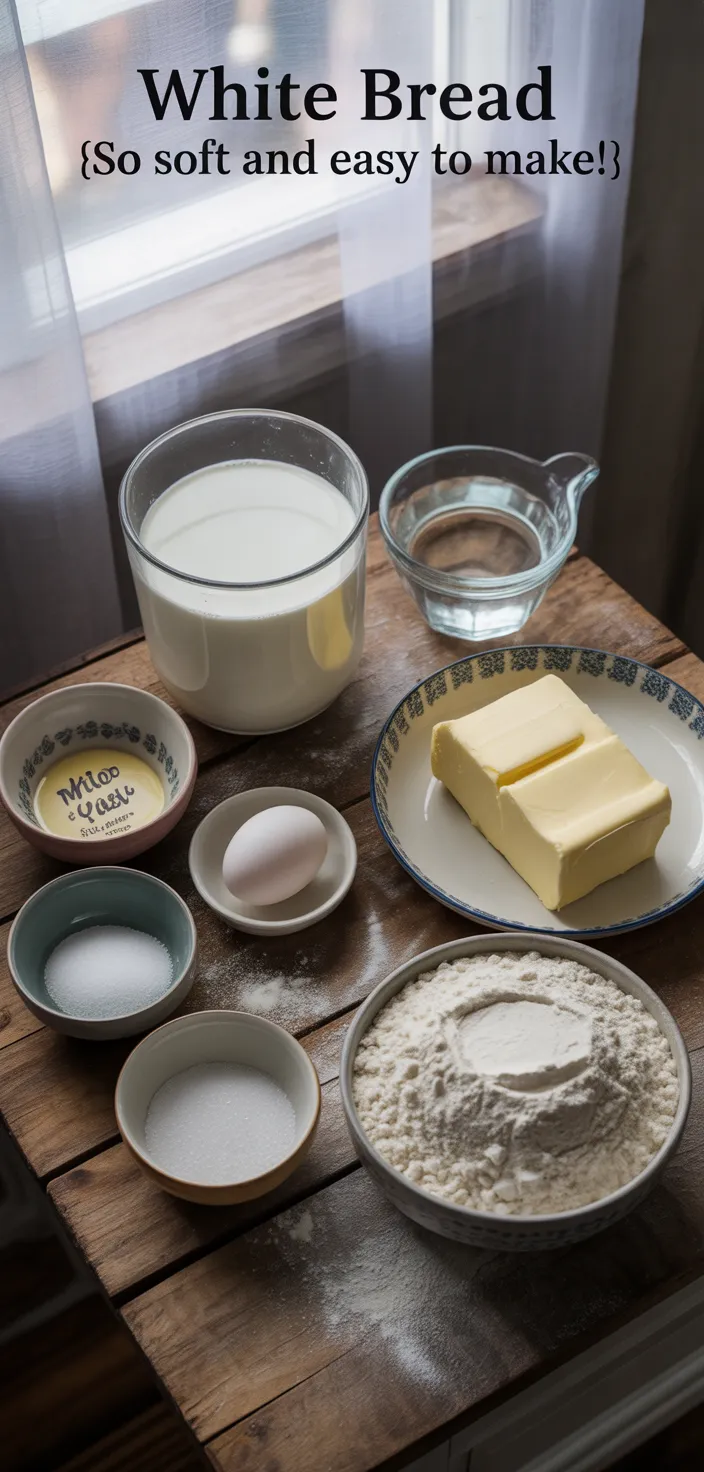
- Adds softness, a bit of protein and fat, helps browning and richer flavor
- Main source of carbs and gluten, gives structure; bread flour makes chewier crumb
- Tiny living organisms that ferment sugars, creating CO2 for airy, soft texture
- Feeds yeast for rise, adds slight sweetness and crust color when baked
- Adds fat for tender crumb, richness and flavor; butter gives nicer crust and taste
- Controls yeast activity, enhances flavor and strengthens gluten for better dough handling
- Adds protein for structure, helps color and a slightly richer, more cake like crumb
Ingredient Quantities
- 1 cup (240 ml) whole milk, warmed to about 110°F (43°C)
- 1/2 cup (120 ml) warm water, about 110°F (43°C)
- 2 1/4 teaspoons (one 7 g packet) active dry yeast
- 2 tablespoons (25 g) granulated sugar
- 1 1/2 teaspoons (8 g) fine sea salt
- 3 to 3 1/2 cups (360 to 420 g) all purpose flour, plus extra for dusting — or use bread flour for a chewier crumb
- 3 tablespoons (45 g) unsalted butter, softened, or 3 tablespoons neutral oil
- 1 large egg, room temperature (optional, for richer crumb and nicer color)
- Extra flour or oil for your hands and work surface as needed
- Nonstick spray or extra butter for greasing a 9×5 inch loaf pan
How to Make this
1. Warm the milk and water to about 110°F 43°C, pour into a large bowl, sprinkle the yeast and sugar over the surface, stir once and let sit 5 to 10 minutes until foamy and smelling yeasty.
2. Add the softened butter or oil and the room temperature egg if you’re using it, stir to combine, then mix in about 3 cups of the flour plus the salt until a shaggy dough forms, adding more flour a little at a time if it’s too sticky.
3. Turn the dough out onto a lightly floured surface or oil your hands and work surface, and knead about 8 to 10 minutes by hand or 5 to 6 minutes in a stand mixer with a dough hook, until the dough is smooth, elastic and slightly tacky but not sticking to your fingers.
4. Lightly oil a clean bowl, put the dough in, cover with plastic wrap or a clean towel, and let it rise in a warm draft free spot until doubled, about 1 to 1 1/2 hours.
5. Gently punch the dough down to deflate, turn it out and shape it into a loaf by flattening into a rectangle then rolling tightly so the seam is on the bottom, tuck ends under so it fits a greased 9×5 inch loaf pan.
6. Spray or butter the loaf pan, place the shaped dough inside, cover again and let rise until puffy and about 1 inch above the rim of the pan, roughly 30 to 45 minutes; meanwhile preheat your oven to 350°F 175°C.
7. Optional: brush the top with a little milk or a beaten egg for a shinier, deeper brown crust, then bake in the center of the preheated oven for 30 to 35 minutes until the top is golden and the loaf sounds hollow when tapped or an instant read thermometer reads about 190 to 200°F 88 to 93°C.
8. Immediately brush the hot loaf with a little melted butter for a softer crust and nicer flavor, let the bread cool in the pan 10 minutes then turn out onto a wire rack to finish cooling; slicing too soon will make it gummy so try to wait at least 30 to 60 minutes.
9. Notes and quick hacks: if dough looks too wet add flour a tablespoon at a time, if it wont rise your liquids were probably too hot or your yeast old, using bread flour gives a chewier crumb, and you can store sliced bread wrapped at room temp for 2 days or freeze for up to 3 months.
Equipment Needed
1. Large mixing bowl
2. Measuring cups and spoons plus a liquid measuring cup (or kitchen scale)
3. Small saucepan or microwave-safe bowl to warm milk and water
4. Instant-read thermometer
5. Stand mixer with dough hook or a sturdy wooden spoon for hand-kneading
6. Bench scraper or spatula for turning and shaping dough
7. 9×5 inch loaf pan and nonstick spray or butter for greasing
8. Pastry brush for egg or milk wash and for brushing melted butter
9. Plastic wrap or clean kitchen towel for covering rises and a wire cooling rack
FAQ
White Bread {So Soft And Easy To Make!} Recipe Substitutions and Variations
- Milk swap: use 1 cup buttermilk warmed to about 110°F or 1 cup unsweetened soy/almond/cashew milk warmed. Buttermilk gives a little tang and a softer crumb, non dairy works 1:1 too.
- Yeast swap: use instant yeast in place of active dry. Use the same amount (about 2 1/4 tsp) but stir it into the dry ingredients instead of proofing it, dough will rise a bit faster so keep an eye on it.
- Fat swap: replace the 3 tbsp unsalted butter with 3 tbsp neutral oil (canola, vegetable or light olive) or use 3 tbsp melted butter if you forgot to soften it. Oil keeps the loaf soft longer, melted butter gives richer flavor.
- Egg swap: omit the egg and use 1/4 cup unsweetened applesauce for moisture, or make a flax “egg” by mixing 1 tbsp ground flaxseed with 3 tbsp water and letting it sit 5 minutes. Applesauce adds slight sweetness, flax helps with structure.
Pro Tips
– Make sure the yeast actually wakes up. Warm the milk and water to about 110°F and give the yeast 5 to 10 minutes to get foamy. If it doesnt bubble, toss it and start over with fresh yeast — your dough won’t rise properly otherwise.
– Use weight not cups when you can, and resist adding too much flour while kneading. The dough should be slightly tacky not dry. If it feels sticky, oil your hands or the board instead of dumping flour in, adding flour makes the loaf dense and heavy. Try the windowpane test to know when to stop kneading.
– Shape tight and proof smart. After the first rise press the gas out gently and roll the loaf tightly with the seam on the bottom so you get a good oven spring. For the final rise poke your finger gently — if the dent springs back quickly it needs more time, if it stays dented it’s overproofed.
– Watch the bake and don’t slice too soon. If the top is browning too fast tent with foil. Bake until the center reads around 190 to 200°F, brush with melted butter right out of the oven for a soft crust, then let it cool at least 30 to 60 minutes before slicing or it will be gummy.
White Bread {So Soft And Easy To Make!} Recipe
My favorite White Bread {So Soft And Easy To Make!} Recipe
Equipment Needed:
1. Large mixing bowl
2. Measuring cups and spoons plus a liquid measuring cup (or kitchen scale)
3. Small saucepan or microwave-safe bowl to warm milk and water
4. Instant-read thermometer
5. Stand mixer with dough hook or a sturdy wooden spoon for hand-kneading
6. Bench scraper or spatula for turning and shaping dough
7. 9×5 inch loaf pan and nonstick spray or butter for greasing
8. Pastry brush for egg or milk wash and for brushing melted butter
9. Plastic wrap or clean kitchen towel for covering rises and a wire cooling rack
Ingredients:
- 1 cup (240 ml) whole milk, warmed to about 110°F (43°C)
- 1/2 cup (120 ml) warm water, about 110°F (43°C)
- 2 1/4 teaspoons (one 7 g packet) active dry yeast
- 2 tablespoons (25 g) granulated sugar
- 1 1/2 teaspoons (8 g) fine sea salt
- 3 to 3 1/2 cups (360 to 420 g) all purpose flour, plus extra for dusting — or use bread flour for a chewier crumb
- 3 tablespoons (45 g) unsalted butter, softened, or 3 tablespoons neutral oil
- 1 large egg, room temperature (optional, for richer crumb and nicer color)
- Extra flour or oil for your hands and work surface as needed
- Nonstick spray or extra butter for greasing a 9×5 inch loaf pan
Instructions:
1. Warm the milk and water to about 110°F 43°C, pour into a large bowl, sprinkle the yeast and sugar over the surface, stir once and let sit 5 to 10 minutes until foamy and smelling yeasty.
2. Add the softened butter or oil and the room temperature egg if you’re using it, stir to combine, then mix in about 3 cups of the flour plus the salt until a shaggy dough forms, adding more flour a little at a time if it’s too sticky.
3. Turn the dough out onto a lightly floured surface or oil your hands and work surface, and knead about 8 to 10 minutes by hand or 5 to 6 minutes in a stand mixer with a dough hook, until the dough is smooth, elastic and slightly tacky but not sticking to your fingers.
4. Lightly oil a clean bowl, put the dough in, cover with plastic wrap or a clean towel, and let it rise in a warm draft free spot until doubled, about 1 to 1 1/2 hours.
5. Gently punch the dough down to deflate, turn it out and shape it into a loaf by flattening into a rectangle then rolling tightly so the seam is on the bottom, tuck ends under so it fits a greased 9×5 inch loaf pan.
6. Spray or butter the loaf pan, place the shaped dough inside, cover again and let rise until puffy and about 1 inch above the rim of the pan, roughly 30 to 45 minutes; meanwhile preheat your oven to 350°F 175°C.
7. Optional: brush the top with a little milk or a beaten egg for a shinier, deeper brown crust, then bake in the center of the preheated oven for 30 to 35 minutes until the top is golden and the loaf sounds hollow when tapped or an instant read thermometer reads about 190 to 200°F 88 to 93°C.
8. Immediately brush the hot loaf with a little melted butter for a softer crust and nicer flavor, let the bread cool in the pan 10 minutes then turn out onto a wire rack to finish cooling; slicing too soon will make it gummy so try to wait at least 30 to 60 minutes.
9. Notes and quick hacks: if dough looks too wet add flour a tablespoon at a time, if it wont rise your liquids were probably too hot or your yeast old, using bread flour gives a chewier crumb, and you can store sliced bread wrapped at room temp for 2 days or freeze for up to 3 months.